Americans have more retirement account options than almost any other country’s savers — and, according to new research, less confidence than ever that those options will be enough. The Employee Benefit Research Institute (EBRI), in its 36th annual Retirement Confidence Survey conducted with Greenwald Research, found that only 64% of Americans now feel confident they’ll have enough money to live comfortably in retirement, with worker confidence dropping to its lowest level since 2017. EBRI’s Craig Copeland pointed to a familiar mix of pressures: “Americans are contending with a mix of immediate financial pressures and long-term uncertainty. Many workers are struggling with debt, inflation and rising housing and health care costs.”
Against that backdrop, choosing the right retirement account — and actually understanding what each one offers — matters more than ever. This guide compares every major retirement account available to American workers in 2026, using the newly updated IRS contribution limits and rankings and analysis from Forbes Advisor, NerdWallet, Fidelity, and Vanguard, so you can see, side by side, which accounts fit which situations.
Why 2026 is a notable year for retirement accounts
Every year, the IRS adjusts contribution limits for inflation, but 2026’s adjustments are larger than usual across nearly every account type. According to the IRS’s official cost-of-living notice (Notice 2025-67), 401(k) limits, IRA limits, SEP IRA limits, SIMPLE IRA limits, and HSA limits all increased for 2026, alongside a new SECURE 2.0 Act provision requiring certain higher-income earners age 50-plus to make catch-up contributions on a Roth basis rather than pre-tax. Understanding these updated numbers is the first step to comparing accounts intelligently.
The full lineup: retirement accounts available to U.S. savers
1. Employer-sponsored 401(k) and 403(b) plans
The workhorse of American retirement savings. Offered through an employer, these plans let you defer part of your paycheck before tax (traditional) or after tax with tax-free growth (Roth), often with an employer match attached.
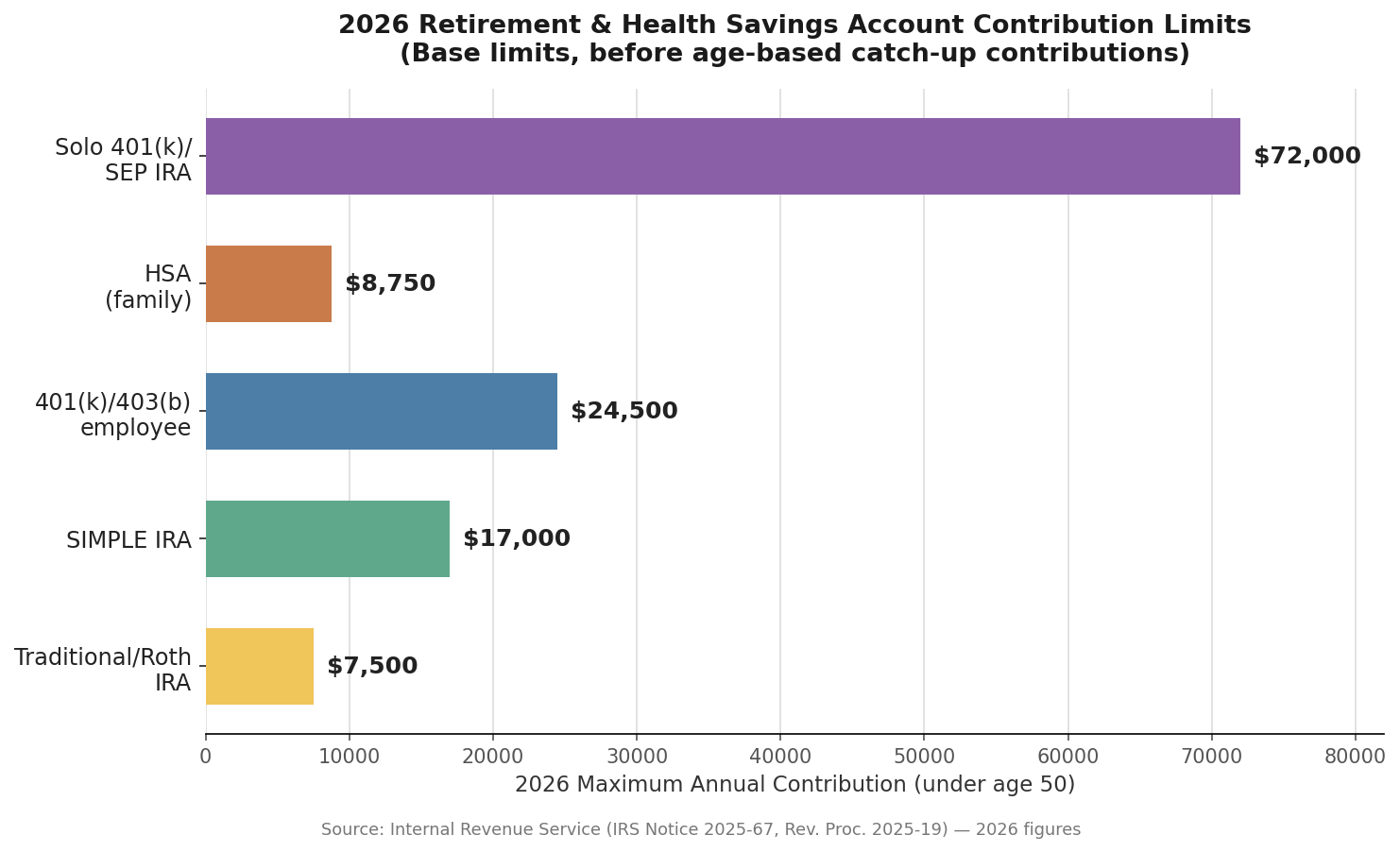
2026 limits: Employee contributions up to $24,500 (up from $23,500 in 2025). Combined employee and employer contributions can reach $72,000. Catch-up contributions for those 50-plus rise to $8,000, and workers aged 60–63 get an enhanced “super catch-up” of $11,250, per IRS figures confirmed by Fidelity and Chase.
Best for: Nearly everyone with access to one, especially if there’s an employer match — widely considered the single best “free money” opportunity in personal finance.
2. Traditional IRA
An individual account you open independently of any employer, funded with contributions that may be tax-deductible depending on your income and workplace coverage.
2026 limits: $7,500 combined across all IRAs (traditional and Roth together), up from $7,000. Catch-up for age 50-plus rises to $1,100, for a total of $8,600.
Best for: Supplementing a 401(k), or as a primary account for those without access to an employer plan. Forbes Advisor notes IRAs function as a flexible “container” that can hold anything from FDIC-insured CDs to stocks, ETFs, and mutual funds — a much broader menu than most workplace plans allow.
3. Roth IRA
The mirror image of a traditional IRA: contributions are after-tax, but qualified withdrawals in retirement — including all investment growth — are entirely tax-free.
2026 limits: Same $7,500 base limit (shared with traditional IRA contributions), but eligibility phases out based on income. For 2026, the IRS raised the phase-out range to $153,000–$168,000 for single filers and heads of household, and $242,000–$252,000 for married couples filing jointly.
Best for: Younger savers and anyone who expects to be in a higher tax bracket in retirement than they are today. NerdWallet’s 2026 analysis names Charles Schwab as its top overall pick for Roth IRAs, with Fidelity highlighted for holistic retirement planning tools.
4. SEP IRA (Simplified Employee Pension)
An employer-funded plan popular with self-employed individuals and small business owners, funded entirely through employer contributions — there’s no employee salary-deferral option.
2026 limits: Employers can contribute up to 25% of compensation, capped at $72,000, up from $70,000 in 2025, according to Fidelity and the IRS. SEP IRAs don’t allow catch-up contributions at any age.
Best for: Self-employed people with fluctuating income who want a simple, low-administration plan. Fidelity notes SEP IRAs come with low administrative fees and don’t require annual filings, though the contribution ceiling depends heavily on income — reaching the full $72,000 requires roughly $288,000 in compensation.
5. SIMPLE IRA
Designed for small businesses with fewer than 100 employees, requiring the employer to either match contributions or make a fixed contribution on behalf of every eligible employee.
2026 limits: Employee contributions up to $17,000, up from $16,500 in 2025, according to the IRS, with certain SECURE 2.0-eligible plans allowed to offer higher limits.
Best for: Employees of small businesses where a full 401(k) isn’t offered; simpler and cheaper for employers to administer than a traditional 401(k).
6. Solo 401(k)
Built for self-employed individuals with no full-time employees other than themselves (and possibly a spouse), a Solo 401(k) allows contributions in two capacities: as “employee” and as “employer.”
2026 limits: Employee deferrals up to $24,500 (or $32,500 if 50-plus), plus employer contributions, for a combined cap of $72,000 (or $80,000 for those 50-plus, and $83,250 for the 60–63 super catch-up group), according to IRA Financial and multiple specialist retirement-account administrators. Many Solo 401(k) plans also allow Roth contributions, a feature SEP IRAs typically lack.
Best for: Self-employed individuals, especially at moderate income levels, who want to maximize contributions. IRA Financial’s 2026 analysis illustrates the gap clearly: a 45-year-old consultant earning $150,000 in net self-employment income could contribute a maximum of $37,500 through a SEP IRA, but up to $62,000 through a Solo 401(k) — a $24,500 difference from being able to also make an employee deferral.
7. Health Savings Account (HSA) — the “stealth” retirement account
Technically a medical savings vehicle, not a retirement account, but frequently recommended by financial institutions as a supplemental retirement tool because of its unique triple tax advantage: contributions are pre-tax, growth is tax-free, and withdrawals for qualified medical expenses are tax-free. After age 65, non-medical withdrawals lose their penalty and are simply taxed like a traditional IRA.
2026 limits: $4,400 for self-only coverage, $8,750 for family coverage, according to the IRS (Revenue Procedure 2025-19). Those 55 and older can add a $1,000 catch-up contribution. Eligibility requires enrollment in a qualifying high-deductible health plan (HDHP).
Best for: Anyone with access to an HSA-eligible health plan who can afford to pay current medical costs out of pocket, letting the HSA balance grow untouched for decades.
A few more worth knowing about
Two additional account types come up often enough to deserve a brief mention, even though they apply to narrower groups:
Thrift Savings Plan (TSP): The retirement plan for federal government employees and uniformed service members functions much like a 401(k), including a 2026 employee contribution limit that mirrors the standard $24,500 figure, plus the same age-based catch-up structure, according to figures published alongside the IRS’s broader 2026 cost-of-living adjustments. Federal employees typically also receive an agency matching contribution, similar in spirit to a private-sector 401(k) match.
Pensions and annuities: Traditional defined-benefit pensions have become far less common outside government and some unionized jobs, but for workers who have access to one, EBRI’s research notes that pension income remains one of the more reliable sources of retirement security precisely because it doesn’t depend on market performance or personal contribution discipline. Annuities purchased independently can provide a similar guaranteed-income feature, though they come with their own fee structures and trade-offs that are worth reviewing carefully with a fee-only advisor before purchasing.
Side-by-side comparison: 2026 contribution limits
| Account Type | 2026 Base Limit | Catch-Up (Age 50+) | Enhanced Catch-Up (Age 60–63) | Income Limits? |
|---|---|---|---|---|
| Traditional IRA | $7,500 | +$1,100 ($8,600 total) | Same as 50+ catch-up | No limit to contribute; deduction may phase out |
| Roth IRA | $7,500 | +$1,100 ($8,600 total) | Same as 50+ catch-up | Yes — phases out $153K–$168K single / $242K–$252K joint |
| 401(k) / 403(b) | $24,500 | +$8,000 ($32,500 total) | +$11,250 ($35,750 total) | No |
| SIMPLE IRA | $17,000 | Higher limits possible under SECURE 2.0 | Special provisions may apply | No |
| SEP IRA | Up to $72,000 (25% of compensation) | None allowed | None allowed | No (but scales with income) |
| Solo 401(k) | Up to $72,000 combined | +$8,000 ($80,000 total) | +$11,250 ($83,250 total) | No |
| HSA (self-only) | $4,400 | +$1,000 (age 55+) | N/A | Requires HDHP enrollment |
| HSA (family) | $8,750 | +$1,000 (age 55+, per spouse) | N/A | Requires HDHP enrollment |
Source: Internal Revenue Service, IRS Notice 2025-67 and Revenue Procedure 2025-19 (2026 cost-of-living adjustments), with figures corroborated by Fidelity, Vanguard, and Chase.
Traditional vs. Roth: the decision inside the decision
Almost every account above comes in both a traditional and Roth flavor. The core trade-off is about timing, not total benefit: a traditional account reduces your taxable income now, with withdrawals taxed as ordinary income later; a Roth account contributes after-tax dollars now, with tax-free withdrawals later. Forbes Advisor and NerdWallet both frame the decision around a single question: do you expect your tax rate to be higher or lower in retirement than it is today? Neither publication treats this as a question with a universal right answer — it depends on your specific income trajectory, and both recommend involving a tax professional or fee-only financial planner for anything beyond a rough estimate.
Which account is genuinely “best”? It depends on your situation
Rather than naming one account as universally superior, financial-institution guidance converges on a fairly consistent hierarchy based on employment situation:
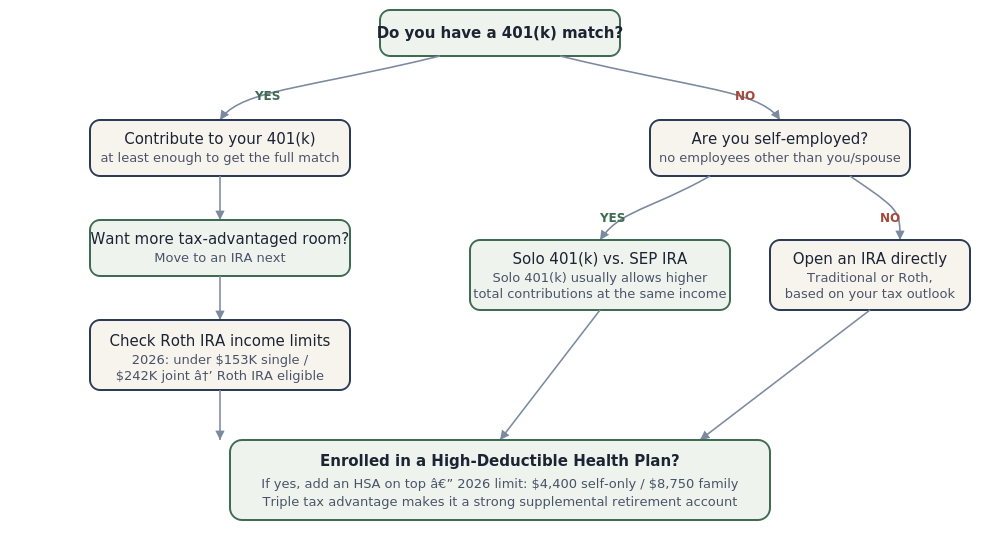
If you’re a traditional employee with a 401(k) match: Start there. An employer match is close to a guaranteed, immediate return that no IRA or investment account can replicate. Contribute at least enough to capture the full match before considering other accounts.
If you’ve captured the match and want more tax-advantaged room: A Roth or traditional IRA is typically next, offering more investment flexibility than most 401(k) fund menus. Forbes Advisor’s 2026 ratings named Fidelity the top-rated overall IRA provider, citing strong marks for consumer satisfaction and account features, while NerdWallet’s separate Roth IRA analysis named Charles Schwab its top overall pick for that account type specifically.
If you’re self-employed with no employees: The comparison generally favors a Solo 401(k) over a SEP IRA for most income levels, because the ability to make employee deferrals on top of employer contributions typically allows for significantly higher total contributions at the same income — the earlier $150,000-income example showed a difference of $24,500 in favor of the Solo 401(k). A SEP IRA remains attractive for its simplicity and lower administrative burden, particularly for business owners who don’t want to manage a more complex plan.
If you run a small business with employees: A SIMPLE IRA is often the practical starting point — it’s less expensive and less administratively demanding than a standard 401(k), while still requiring an employer contribution that benefits employees.
If you have access to an HDHP: Financial institutions increasingly recommend treating an HSA as a de facto retirement account layered on top of whichever plan above applies to you, given its unmatched triple tax advantage — a benefit no other account on this list fully replicates.
What the research says about actual savings behavior
It’s worth grounding all of this in how Americans are actually saving, not just what’s available. EBRI and Greenwald Research’s 2026 survey found that concern about retirement readiness is rising broadly: workers’ confidence in having enough money for a comfortable retirement fell to its lowest point since 2017, and confidence declined among retirees as well, from 78% to 73% year-over-year. The survey also found that a large share of both workers and retirees — roughly seven in ten retirees and four in five workers — expressed concern about potential changes to the broader retirement system, including Social Security and Medicare.
Separately, Vanguard’s “How America Saves” research, cited in CNBC’s 2026 coverage, found that only about 14% of 401(k) participants max out their contributions in a given year — a reminder that the headline limits in the table above represent a ceiling for people in a position to reach it, not a target everyone is expected to hit. Fidelity’s analysis of more than 25,000 corporate retirement plans found the average combined savings rate (employee plus employer contributions) sits at roughly 14.2% of pay.
Quick decision guide
A practical starting checklist
Bringing the comparison down to action, a reasonable sequence for most Americans in 2026 looks like this:
- Confirm whether your employer offers a 401(k) match, and contribute at least enough to capture it in full.
- Decide between traditional and Roth for any account you’re funding, based on your current versus expected future tax bracket.
- Check your Roth IRA eligibility against the 2026 income phase-out ranges before assuming you can or can’t contribute directly.
- If self-employed, compare a Solo 401(k) against a SEP IRA using your actual expected income — the “best” choice depends heavily on your specific numbers.
- If eligible for an HSA, treat it as a stealth retirement account rather than only a medical expense fund, especially if you can afford to pay current medical costs out of pocket.
- Revisit contribution percentages annually, since the limits themselves change every year — what maxed out your account in 2025 may leave room unused in 2026.
The bottom line
There is no single “best” retirement account in America — there’s a best account for your specific employment situation, income, and tax outlook, and in most cases a combination of two or three accounts working together beats relying on just one. The 2026 limit increases give savers more room across nearly every account type, but as EBRI’s research makes clear, having access to good accounts and feeling confident about retirement are two different things — the accounts are only as effective as the consistent contributions behind them. Understanding exactly what each account offers, and matching it honestly to your own circumstances, is a more reliable path to retirement security than chasing whichever account happens to have the highest headline contribution limit.
Sources consulted: Employee Benefit Research Institute (EBRI) and Greenwald Research 2026 Retirement Confidence Survey, Internal Revenue Service (irs.gov, Notice 2025-67, Revenue Procedure 2025-19), Forbes Advisor, NerdWallet, Fidelity, Vanguard, J.P. Morgan/Chase, IRA Financial, Directed IRA, and CNBC (2026 reporting).